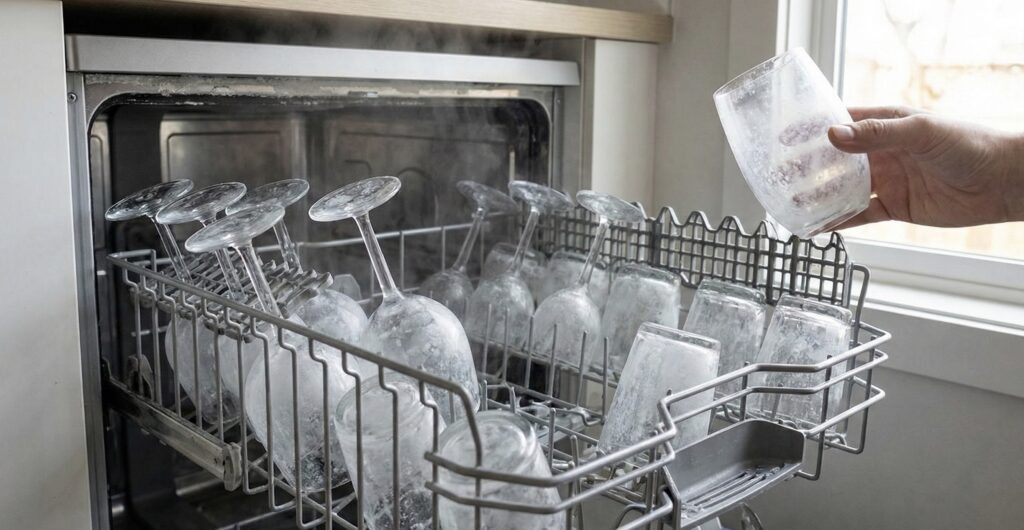
A persistent white or cloudy film on dishes is a classic indicator of scale-forming minerals in the water supply. Although often attributed to detergent residue or dishwasher malfunction, this phenomenon is fundamentally a water chemistry issue, not a cleaning failure.
Understanding the mechanism behind this residue is essential for choosing an effective, long-term solution.
The Chemistry Behind White Residue on Dishes
Most municipal and well water contains dissolved calcium (Ca²⁺) and magnesium (Mg²⁺) ions. When water hardness reaches moderate to high levels, these minerals remain dissolved only as long as water stays cool and stable.
During a dishwasher cycle:
- Water is heated
- Mineral solubility decreases
- Water evaporates during drying
- Minerals precipitate and crystallize
The result is the formation of calcium carbonate and related mineral deposits, which adhere to dishware surfaces—particularly glass, ceramic, and stainless steel. Once these minerals have precipitated, they are no longer removable by rinsing because they are no longer dissolved in water.
This is why dishes may appear clean but still look cloudy or chalky.
Why Detergent Changes Rarely Solve the Problem
Hard water directly interferes with detergent chemistry. Calcium and magnesium ions bind with surfactants, reducing cleaning efficiency and forming insoluble residues commonly referred to as soap scum.
As a result:
- Increasing detergent dosage often worsens residue
- Rinse aids offer only limited improvement
- Higher wash temperatures accelerate mineral precipitation
The issue is not insufficient cleaning power—it is mineral behavior under heat and evaporation.
White Film as a System-Level Warning Sign
The visible residue on dishes is only the most obvious symptom. The same mineral precipitation process occurs inside:
- Dishwasher heating elements
- Spray arms and valves
- Hot water heaters
- Household plumbing
Scale acts as an insulating layer, reducing heat transfer efficiency, increasing energy consumption, and accelerating mechanical wear. Over time, this leads to reduced appliance lifespan and higher maintenance costs.
Why Conventional Water Softeners Are Not Always Ideal
Traditional ion-exchange water softeners eliminate hardness by replacing calcium and magnesium with sodium or potassium ions. While effective at preventing scale, this approach introduces secondary concerns:
- Elevated sodium levels in household water
- Increased corrosion potential in certain plumbing materials
- Environmental impact from brine discharge
- Ongoing operational and maintenance requirements
For applications where mineral retention and ecological operation are priorities, alternative scale-control strategies are preferable.
A Modern Approach: Scale Reduction Without Mineral Removal
Rather than removing hardness minerals, modern systems focus on modifying how minerals crystallize and interact with surfaces. By controlling nucleation and crystal growth, minerals can remain present in the water without forming hard, adherent scale.
This is the design philosophy behind the TipaTech T-18 Ecological Whole-House Filtration System.
TipaTech T-18: Whole-House Mineral Behavior Control
The T-18 treats all incoming water at the point of entry, addressing mineral behavior before water reaches dishwashers, heaters, or fixtures.
Key technical characteristics include:
- Multi-stage filtration for particulates, metals, and chemical contaminants
- Salt-free, electricity-free operation
- No wastewater or chemical discharge
- Preservation of essential minerals such as calcium and magnesium
By reducing the tendency of hardness minerals to precipitate and adhere, the T-18 significantly limits scale formation throughout the plumbing system.
Enhancing Performance with the Omega Limescale Reduction Cartridge
In regions with higher hardness levels or aggressive scale conditions, the T-18 system can be extended with the Omega Limescale Reduction cartridge, a dedicated module designed to further suppress mineral deposition.
How the Omega Cartridge Works
The Omega Limescale Reduction cartridge is engineered to alter the crystallization pathway of calcium and magnesium ions. Instead of forming large, adhesive crystals, minerals are encouraged to form microscopic, non-adherent crystal structures that remain suspended in the water.
These modified mineral particles:
- Do not readily bond to surfaces
- Are far less likely to precipitate during heating and drying
- Pass harmlessly through appliances and plumbing
This directly addresses the root cause of white residue on dishes: mineral precipitation during evaporation.
Impact on Dishware and Appliances
With the T-18 combined with the Omega Limescale Reduction cartridge:
- Glassware maintains clarity without clouding
- Chalky residue on plates and cutlery is significantly reduced
- Dishwasher heating elements remain cleaner
- Thermal efficiency improves
- Appliance service life is extended
All of this is achieved without ion exchange, meaning minerals are managed rather than removed.
Whole-House Benefits
Because treatment occurs at the point of entry, benefits extend beyond dishwashers to:
- Faucets and fixtures
- Shower glass
- Coffee machines and kettles
- Hot water systems
The water remains mineral-rich but no longer scale-forming.
Conclusion
A white film on dishes is not a detergent problem, it is a predictable outcome of untreated mineral-rich water exposed to heat and evaporation. Addressing the issue at the appliance level treats symptoms, not cause.
By combining whole-house conditioning through the TipaTech T-18 with targeted mineral behavior control via the Omega Limescale Reduction cartridge, scale formation is suppressed at its source. Cleaner dishes are simply the most visible confirmation that water chemistry is finally under control.
References
- Hard water leads to calcium and magnesium deposits that form scale when water evaporates and dries on surfaces. Wikipedia
- White film and cloudy residue on dishware are common results of mineral buildup associated with hard water, as indicated by appliance manufacturers and water treatment analysis. Cascade Clean
- Mineral scale buildup inside dishwashers can impede performance and increase maintenance needs. home gear geek