ph water
Table of Contents

pH-balanced water is usually water whose acidity or basicity falls within a desired range for drinking, plumbing, treatment, or a particular process. The term sounds precise, but it does not have one universal health definition.

pH is an important water-quality measurement. It affects taste, corrosion, scale, disinfection, and how some treatment processes perform. It is not, by itself, a score for hydration, mineral quality, or medical benefit.

What pH Measures

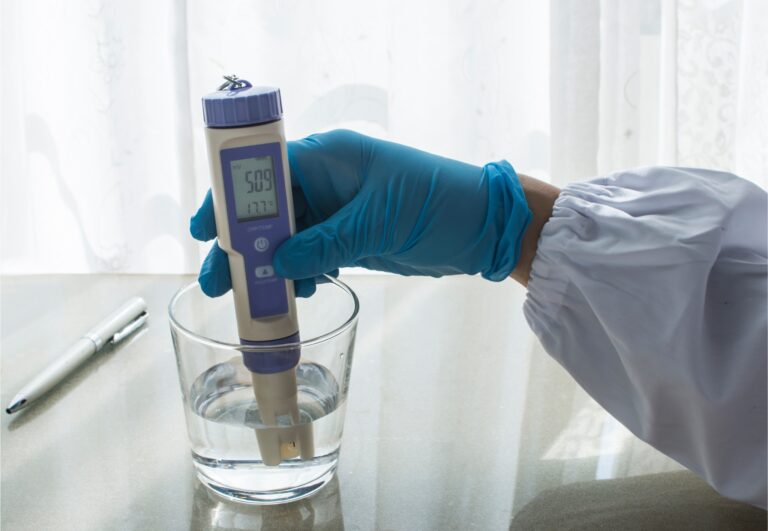
pH describes the concentration and activity of hydrogen ions on a logarithmic scale. A pH of 7 is neutral under standard reference conditions. Lower values are more acidic and higher values are more basic or alkaline.

Because the scale is logarithmic, a change of one pH unit represents a tenfold change in hydrogen-ion activity. That makes careful measurement important. Temperature, storage, carbon dioxide, and the testing method can all influence the result.

pH and Alkalinity Are Not the Same

pH tells you the current acidic or basic condition. Alkalinity describes the water’s ability to resist a change in pH, often because of bicarbonate and carbonate.

Two waters can have a similar pH but very different alkalinity. One may shift quickly when exposed to air or treatment, while the other remains stable. This distinction matters when designing corrosion control, remineralization, or acid-neutralization treatment.

Why pH Matters in Household Water

Corrosion

Low-pH or low-alkalinity water can contribute to corrosion under certain plumbing conditions. Corrosion may release metals from pipes, solder, and fixtures. pH is only one part of the assessment; alkalinity, dissolved oxygen, chloride, temperature, pipe material, and water age also matter.

Scale

Higher pH can increase the tendency of calcium carbonate to precipitate when hardness and alkalinity are present. Scale potential cannot be predicted from pH alone.

Taste

Very low or high pH can affect taste. Mineral content, chlorine, organic compounds, and plumbing can also influence what the user perceives.

Disinfection and Treatment

pH affects the performance of chlorine and other treatment processes. Utilities manage pH as part of a larger treatment strategy rather than as a stand-alone wellness target.

Does pH-Balanced Water Change the Body’s pH?

The body tightly regulates blood pH through breathing, kidney function, and chemical buffers. Drinking alkaline or acidic water does not meaningfully reset blood pH in a healthy person.

Water can temporarily affect the pH inside the mouth or stomach, but the stomach is naturally acidic and the body continuously adjusts. Claims that one water pH detoxifies the body, prevents disease, boosts immunity, or reverses aging require clinical evidence that a pH reading alone cannot provide.

Is Alkaline Water Better?

Alkaline water may taste better to some people and may contain calcium, magnesium, bicarbonate, or added minerals. Those characteristics should be measured directly. A high pH does not prove that the water contains useful minerals, has a negative ORP, contains molecular hydrogen, or offers a particular health effect.

For a deeper review of the claims and limitations, see Alkaline Water: Myth, Marketing and What pH Really Means.

What Is a Reasonable pH for Drinking Water?

Public-water guidance commonly treats pH as an operational and aesthetic parameter rather than a direct indicator of health. The appropriate range depends on treatment, source water, corrosion control, distribution conditions, and local requirements.

A single home reading outside an expected range should be confirmed with a calibrated method. Private-well owners should also test for contaminants that pH cannot reveal, including bacteria, nitrate, arsenic, and metals where locally relevant.

How Water Treatment Can Change pH

Acid-Neutralizing Media

Calcite and similar media can dissolve into acidic water, increasing calcium, alkalinity, and pH. The final result depends on contact time, flow, source-water chemistry, and media condition.

Reverse Osmosis

RO reduces many dissolved ions and can produce water with low alkalinity. The measured pH may shift after exposure to air. Some systems use remineralization to improve taste or finished-water stability.

Ion Exchange and Softening

Conventional softening mainly changes hardness ions. It does not automatically correct low pH or alkalinity.

Carbon and Fine Filtration

Standard carbon and particle filters may change taste and selected contaminants but are not automatically pH-balancing systems.

Where TipaTech Fits

According to TipaTech’s current product information, the Lotus DY is designed to influence several drinking-water characteristics, including pH and ORP, depending on the source water and configuration. These measurements should be reported under defined conditions and should not be converted into broad medical claims.

The T-18 is positioned for whole-house filtration and scale management. Scale treatment, mineral retention, pH adjustment, and contaminant reduction are separate performance questions.

Readers interested in oxidation-reduction measurements can review What Is ORP in Water?

The Bottom Line

pH-balanced water is water managed within a suitable range for its source, plumbing, treatment, and intended use. pH matters, but it does not determine water safety or health value by itself. A sound assessment looks at pH together with alkalinity, minerals, corrosion conditions, contaminants, and verified treatment performance.

Frequently Asked Questions

What is pH-balanced water?

It generally means water whose pH is within a desired range for drinking, treatment, plumbing, or a specific process. The phrase has no single health-based definition.

Does drinking alkaline water change blood pH?

In healthy people, the body tightly regulates blood pH through the lungs and kidneys. Drinking water does not meaningfully override that system.

Is neutral pH always best for drinking water?

Not necessarily. Acceptable pH depends on source water, treatment, corrosion control, taste, and local requirements. pH alone does not determine whether water is safe.

What is the difference between pH and alkalinity?

pH describes how acidic or basic the water is at the time of measurement. Alkalinity describes its capacity to resist a change in pH.

Can a water filter balance pH?

Some media and treatment systems can raise or lower pH. The result depends on source-water chemistry, flow, contact time, media condition, and system design.

whole house water filtration systems

Cleaner. Smarter. Healthier

At TipaTech we specialize in advanced whole house water filtration systems designed to protect your health and improve your water at every tap. Our patented technology reduces lead, bacteria, microplastics and harmful chemicals while preserving essential minerals like magnesium. Tested and Certified by IAPMO Compliance to: NSF/ANSI 42/61/372-2022 standards. Our systems deliver safe, eco-friendly, antioxidant-rich water with no electricity, no waste and no compromises.

Make Your Water Smarter

This article is for informational purposes only and is not medical advice. TipaTech products are designed to support water quality, not to diagnose, treat, cure, or prevent any disease. Product performance varies based on source water, usage, and professional installation. TipaTech disclaims any liability arising from reliance on this content.

About the Author

Baruch Ziser

Founder & Senior Scientific Consultant | Inventor of the TipaTech Filtration Systems

Baruch Ziser is a leading expert in water technology with fifty years of experience. As the inventor of TipaTech filters and a senior scientist at the Technion’s INOVATEC program, he has developed advanced water systems that reduce impurities while retaining and adding the necessary minerals for optimal body function. His innovations are recognized globally for improving drinking water quality in homes and agriculture.

The TipaTech Water Filtration Systems have been Tested and Certified by IAPMO

& Compliance to NSF/ANSI/CAN standards

NSF/ANSI/CAN Standards | IAPMO, R&T, UPC and the Standards Council of Canada

More to Know

DID YOU KNOW?  ·  WATER & HEALTH

pH-Balanced Water: What pH Means and What It Does Not

Learn what pH-balanced water means, how pH differs from alkalinity, why it matters for plumbing and treatment, and what pH cannot prove.

By Baruch Ziser Updated July 13, 2026 4 min read
pH-Balanced Water: What pH Means and What It Does Not
TOPICWater & Health
READING TIME4 minutes
FIRST PUBLISHEDAugust 28, 2025

pH-balanced water is usually water whose acidity or basicity falls within a desired range for drinking, plumbing, treatment, or a particular process. The term sounds precise, but it does not have one universal health definition.

pH is an important water-quality measurement. It affects taste, corrosion, scale, disinfection, and how some treatment processes perform. It is not, by itself, a score for hydration, mineral quality, or medical benefit.

What pH Measures

pH describes the concentration and activity of hydrogen ions on a logarithmic scale. A pH of 7 is neutral under standard reference conditions. Lower values are more acidic and higher values are more basic or alkaline.

Because the scale is logarithmic, a change of one pH unit represents a tenfold change in hydrogen-ion activity. That makes careful measurement important. Temperature, storage, carbon dioxide, and the testing method can all influence the result.

pH and Alkalinity Are Not the Same

pH tells you the current acidic or basic condition. Alkalinity describes the water's ability to resist a change in pH, often because of bicarbonate and carbonate.

Two waters can have a similar pH but very different alkalinity. One may shift quickly when exposed to air or treatment, while the other remains stable. This distinction matters when designing corrosion control, remineralization, or acid-neutralization treatment.

Why pH Matters in Household Water

Corrosion

Low-pH or low-alkalinity water can contribute to corrosion under certain plumbing conditions. Corrosion may release metals from pipes, solder, and fixtures. pH is only one part of the assessment; alkalinity, dissolved oxygen, chloride, temperature, pipe material, and water age also matter.

Scale

Higher pH can increase the tendency of calcium carbonate to precipitate when hardness and alkalinity are present. Scale potential cannot be predicted from pH alone.

Taste

Very low or high pH can affect taste. Mineral content, chlorine, organic compounds, and plumbing can also influence what the user perceives.

Disinfection and Treatment

pH affects the performance of chlorine and other treatment processes. Utilities manage pH as part of a larger treatment strategy rather than as a stand-alone wellness target.

Does pH-Balanced Water Change the Body's pH?

The body tightly regulates blood pH through breathing, kidney function, and chemical buffers. Drinking alkaline or acidic water does not meaningfully reset blood pH in a healthy person.

Water can temporarily affect the pH inside the mouth or stomach, but the stomach is naturally acidic and the body continuously adjusts. Claims that one water pH detoxifies the body, prevents disease, boosts immunity, or reverses aging require clinical evidence that a pH reading alone cannot provide.

Is Alkaline Water Better?

Alkaline water may taste better to some people and may contain calcium, magnesium, bicarbonate, or added minerals. Those characteristics should be measured directly. A high pH does not prove that the water contains useful minerals, has a negative ORP, contains molecular hydrogen, or offers a particular health effect.

For a deeper review of the claims and limitations, see Alkaline Water: Myth, Marketing and What pH Really Means.

What Is a Reasonable pH for Drinking Water?

Public-water guidance commonly treats pH as an operational and aesthetic parameter rather than a direct indicator of health. The appropriate range depends on treatment, source water, corrosion control, distribution conditions, and local requirements.

A single home reading outside an expected range should be confirmed with a calibrated method. Private-well owners should also test for contaminants that pH cannot reveal, including bacteria, nitrate, arsenic, and metals where locally relevant.

How Water Treatment Can Change pH

Acid-Neutralizing Media

Calcite and similar media can dissolve into acidic water, increasing calcium, alkalinity, and pH. The final result depends on contact time, flow, source-water chemistry, and media condition.

Reverse Osmosis

RO reduces many dissolved ions and can produce water with low alkalinity. The measured pH may shift after exposure to air. Some systems use remineralization to improve taste or finished-water stability.

Ion Exchange and Softening

Conventional softening mainly changes hardness ions. It does not automatically correct low pH or alkalinity.

Carbon and Fine Filtration

Standard carbon and particle filters may change taste and selected contaminants but are not automatically pH-balancing systems.

Where TipaTech Fits

According to TipaTech's current product information, the Lotus DY is designed to influence several drinking-water characteristics, including pH and ORP, depending on the source water and configuration. These measurements should be reported under defined conditions and should not be converted into broad medical claims.

The T-18 is positioned for whole-house filtration and scale management. Scale treatment, mineral retention, pH adjustment, and contaminant reduction are separate performance questions.

Readers interested in oxidation-reduction measurements can review What Is ORP in Water?

The Bottom Line

pH-balanced water is water managed within a suitable range for its source, plumbing, treatment, and intended use. pH matters, but it does not determine water safety or health value by itself. A sound assessment looks at pH together with alkalinity, minerals, corrosion conditions, contaminants, and verified treatment performance.

Frequently Asked Questions

What is pH-balanced water?

It generally means water whose pH is within a desired range for drinking, treatment, plumbing, or a specific process. The phrase has no single health-based definition.

Does drinking alkaline water change blood pH?

In healthy people, the body tightly regulates blood pH through the lungs and kidneys. Drinking water does not meaningfully override that system.

Is neutral pH always best for drinking water?

Not necessarily. Acceptable pH depends on source water, treatment, corrosion control, taste, and local requirements. pH alone does not determine whether water is safe.

What is the difference between pH and alkalinity?

pH describes how acidic or basic the water is at the time of measurement. Alkalinity describes its capacity to resist a change in pH.

Can a water filter balance pH?

Some media and treatment systems can raise or lower pH. The result depends on source-water chemistry, flow, contact time, media condition, and system design.

FROM INFORMATION TO THE RIGHT NEXT STEP

Not sure what is affecting your water?

Start with the water source, available test results, property conditions and the treatment goal. TipaTech can help review the situation before a system is selected.

Baruch Ziser

ABOUT THE AUTHOR

Baruch Ziser

Founder & Senior Scientific Consultant | Inventor of the TipaTech Filtration Systems

Baruch Ziser is a leading expert in water technology with fifty years of experience. As the inventor of TipaTech filters and a senior scientist at the Technion’s INOVATEC program, he has developed advanced water systems that reduce impurities while retaining and adding the necessary minerals for optimal body function. His innovations are recognized globally for improving drinking water quality in homes and agriculture.

The TipaTech Water Filtration Systems have been Tested and Certified by IAPMO

& Compliance to NSF/ANSI/CAN standards

NSF/ANSI/CAN Standards | IAPMO, R&T, UPC and the Standards Council of Canada

Contact Us