Many public water systems use chlorine or chloramine to control microorganisms. That residual protects water as it moves through distribution pipes. It can also affect taste, odor, and the shower experience, especially for people with dry or sensitive skin.
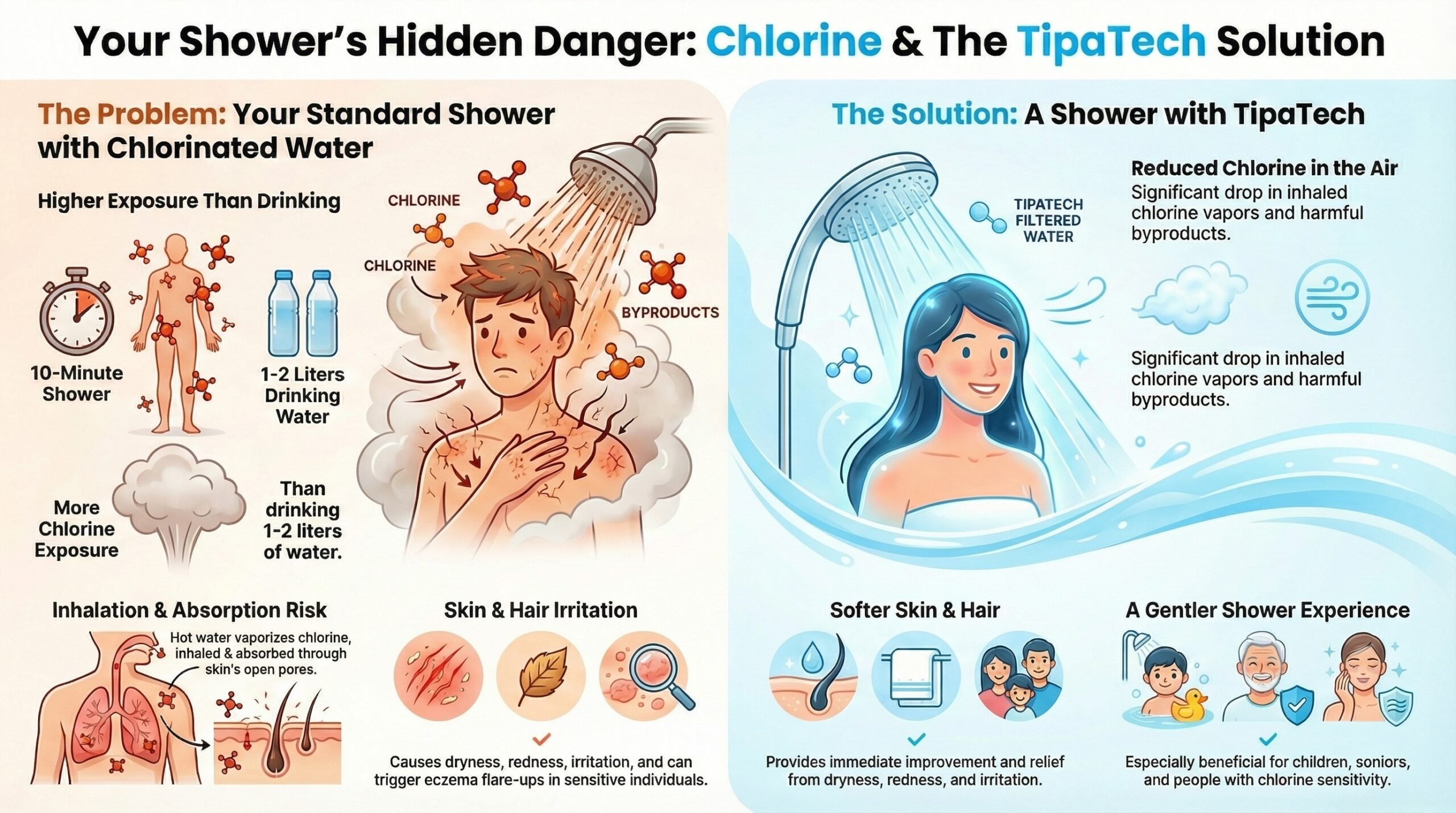
Hot water and spray increase the transfer of some volatile compounds from water into air, but claims that a short shower always causes more chlorine absorption than drinking several liters of water are not reliable universal facts. Exposure depends on disinfectant type, concentration, temperature, ventilation, water chemistry, and the compounds present.
Does Shower Water Contain Chlorine?
If your utility uses free chlorine, some residual may reach the tap. If it uses chloramine, the chemistry and treatment requirements differ. Check the utility report or ask the supplier which disinfectant is used. A pool test strip may provide a rough screening result, but treatment decisions should use an appropriate test method.
Why Chlorine Is Added to Drinking Water
Disinfection is one of the most important public-health protections in a municipal water system. The goal is not to portray chlorine as a toxin that should always be eliminated. The goal is to manage taste, odor, skin comfort, and by-products without compromising microbiological control.
The CDC explains the role of chlorine and chloramine in drinking-water disinfection. Utilities control residuals and monitor regulated disinfection by-products.
What Happens During a Hot Shower?
Spraying and heating water can release volatile substances into bathroom air. Free chlorine itself is reactive, and some chlorinated by-products are more volatile than others. Good ventilation can reduce indoor buildup. The actual exposure cannot be inferred from odor alone.
For sensitive skin, chlorine, hot water, long shower duration, and harsh cleansers may all contribute to dryness or irritation. That does not mean chlorine is the sole cause of eczema or that filtration will cure a skin condition.
Why Removing All Disinfectant at the Main Entry Requires Care
A whole-house system that significantly reduces disinfectant leaves downstream plumbing with less residual protection. That may be acceptable when the system is designed and maintained correctly, but it can increase the importance of hygienic installation, tank management, filter changes, and stagnation control.
Carbon media that is not replaced on schedule can lose performance and become a site for microbial growth. “Chlorine-free everywhere” is not automatically safer.
Shower Filter vs Whole-House Treatment
Shower Filters
Compact shower filters can be convenient, but their capacity and performance vary. Activated carbon works less effectively at high flow and hot temperatures unless the device is designed for those conditions. KDF, vitamin C, calcium sulfite, and other media may be used, each with different limitations.
Whole-House Systems
A point-of-entry system treats water before it reaches showers, laundry, and fixtures. It must be sized for peak flow and maintained to avoid pressure loss and media exhaustion. A sediment rating does not prove chlorine or chloramine reduction.
What to Look for in a Chlorine-Reduction Claim
- Does the claim apply to free chlorine, chloramine, or both?
- What flow rate and capacity were tested?
- Was the test conducted at shower-water temperature?
- Is the exact model certified or independently tested?
- How often must the media be replaced?
- What happens after the rated capacity is reached?
The TipaTech Approach
According to TipaTech’s current product information, the T-18 is a whole-house point-of-entry system. Its one-micron specification concerns particulate filtration and does not, on its own, prove free-chlorine, chloramine, gas, or by-product reduction. Those claims should be tied to the exact installed configuration and applicable test data.
A point-of-use system such as the Lotus DY may serve a different objective at a drinking-water tap. It should not be presented as a substitute for whole-house shower treatment unless the installation actually treats the shower supply.
Practical Steps
- Ask the utility whether it uses chlorine or chloramine.
- Improve bathroom ventilation and avoid unnecessarily hot, long showers.
- Choose a filter with a claim for the actual disinfectant.
- Replace media on schedule and sanitize housings as instructed.
- For persistent skin or respiratory symptoms, seek medical advice rather than relying on a filter alone.
Conclusion
Chlorine in shower water is a legitimate comfort and exposure question, but it should be discussed without exaggerated comparisons. The best solution balances disinfectant reduction, plumbing hygiene, verified performance, and maintenance.
Frequently Asked Questions
Does shower water have chlorine?
It may. Public systems commonly use chlorine or chloramine. Check the utility report to learn which disinfectant reaches your home.
Is chlorine absorbed through the skin during a shower?
Exposure can occur through skin contact and inhalation of volatile compounds, but the amount varies and cannot be reduced to one universal comparison with drinking water.
Do shower filters remove chloramine?
Some are designed for chloramine, but many basic carbon filters perform better for free chlorine. Check the exact product claim and tested capacity.
Is removing all chlorine from whole-house water always safer?
No. Removing disinfectant can make plumbing hygiene and maintenance more important. System design and upkeep matter.
Does a one-micron filter remove chlorine?
Not by particle size alone. Chlorine reduction depends on reactive or adsorptive media and verified performance, not simply the micron rating.