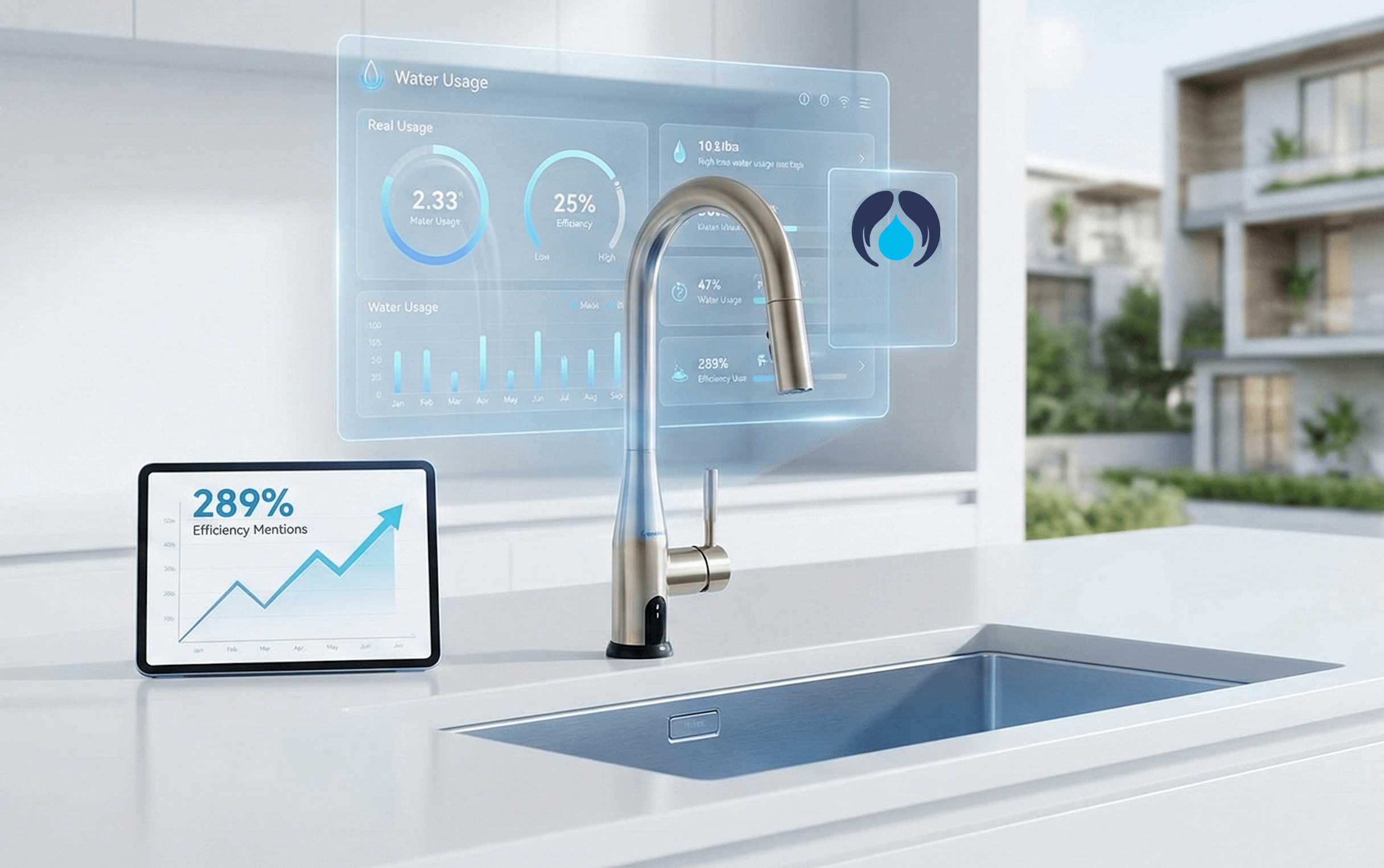
In late 2025, Realtor.com reported a striking change in the language used to market homes: mentions of WaterSense fixtures rose 289.6% year over year. That number is meaningful, but it needs to be interpreted correctly. It does not mean water-efficient homes became 289% more valuable, and it does not prove that one plumbing upgrade will produce a specific price premium.
What it does show is that water efficiency is becoming more visible in real-estate marketing. Buyers, builders, and agents are increasingly treating water performance as a feature worth naming, alongside energy efficiency, EV charging, ventilation, and other practical systems.
What the 289.6% Figure Actually Measures
The Realtor.com 2025 trends analysis compared how often selected features appeared in active listing descriptions during 2024 and 2025. WaterSense fixtures ranked first among the fastest-growing terms, with a 289.6% increase in mentions.
The report also classified WaterSense as a rare feature in listing copy. That matters because a large percentage increase can begin from a relatively small base. The finding is best understood as a signal of growing attention, not proof of universal adoption or guaranteed financial return.
What WaterSense Means
WaterSense is a voluntary labeling program run by the U.S. Environmental Protection Agency. Qualifying products are designed to use less water while meeting program criteria for performance. Depending on the product category, the label may apply to toilets, faucets, showerheads, irrigation controllers, and other fixtures.
A labeled fixture is not the same thing as a water filter. WaterSense addresses efficient use. Filtration and treatment address selected water-quality concerns such as taste, sediment, hardness, or a measured contaminant. A home may benefit from one, both, or neither, depending on its water source and objectives.
Why Water Features Are Becoming More Marketable
Lower operating costs are easier to understand
Buyers can quickly connect efficient fixtures with lower water use. In areas with rising utility rates, drought restrictions, or high wastewater charges, that benefit is especially easy to communicate.
Efficiency is becoming part of home quality
Modern buyers increasingly ask how a home performs, not only how it looks. Insulation, ventilation, solar readiness, leak detection, efficient plumbing, and documented maintenance all contribute to the perception of a well-managed property.
Water resilience is a practical concern
Water scarcity, aging infrastructure, and regional quality issues have made water systems more visible. A buyer may value efficient fixtures, but may also ask about pipe condition, water pressure, hardness, filtration, and maintenance history.
Certification and Evidence Still Matter
Labels, certifications, and independent test reports can help separate a documented claim from marketing language. Organizations such as IAPMO participate in plumbing codes, testing, and product certification. For a practical overview, see how to verify NSF and IAPMO water-filter claims.
Certification must be read narrowly. A product certified for material safety is not automatically certified to reduce every contaminant. A filter tested for chlorine is not automatically proven for lead, arsenic, chloramine, microorganisms, or hardness. Always check the exact standard, model number, capacity, flow conditions, and claimed reduction.
What This Means for Property Owners
For homeowners preparing to sell, the lesson is not to install technology solely because a percentage sounds impressive. The better approach is to prioritize upgrades that solve a real problem, can be documented, and are easy for a buyer to understand.
- Use WaterSense-labeled fixtures where water efficiency is the goal.
- Repair leaks and document plumbing maintenance.
- Test the water before selecting treatment.
- Keep product certificates, laboratory results, invoices, and service records.
- Avoid claiming health protection, contaminant removal, or property-value gains that the evidence does not support.
Where Whole-House Water Management Fits
A whole-house system can be relevant when the objective extends beyond fixture efficiency, such as reducing sediment, addressing scale, or improving water characteristics throughout the property. The correct system depends on laboratory results, plumbing conditions, flow demand, and verified product performance.
TipaTech presents the T-18 whole-house system as one option within this broader category. Homeowners should evaluate the exact model against their water analysis, installation requirements, maintenance plan, and available third-party documentation rather than assume that one system fits every property.
The Bottom Line
The 289.6% rise is a strong marketing signal: water efficiency is moving from a hidden utility issue into the visible language of real estate. It does not establish a guaranteed price premium. The most credible water upgrade is one that is properly specified, professionally installed, documented, and described without exaggeration.
Frequently Asked Questions
Did WaterSense fixtures increase home values by 289%?
No. Realtor.com reported that WaterSense fixtures were mentioned 289.6% more often in listing descriptions year over year. The figure measures listing language, not a 289% increase in property value.
What is a WaterSense fixture?
WaterSense is a U.S. EPA label for qualifying water-efficient products. Labeled fixtures are designed to use less water while meeting program performance criteria.
Do water-efficient fixtures guarantee a higher sale price?
No. They may support a home efficiency story, but sale price depends on location, condition, buyer demand, installation quality, and many other factors.
Is a certified fixture the same as a whole-house water treatment system?
No. A fixture controls water use at a faucet, shower, or toilet. A treatment system addresses selected water-quality issues and should be evaluated against testing and product-specific performance data.
What should homeowners verify before investing in a water upgrade?
Verify the problem being solved, the applicable certification or test data, expected water and energy savings, maintenance requirements, installation compatibility, and total cost of ownership.