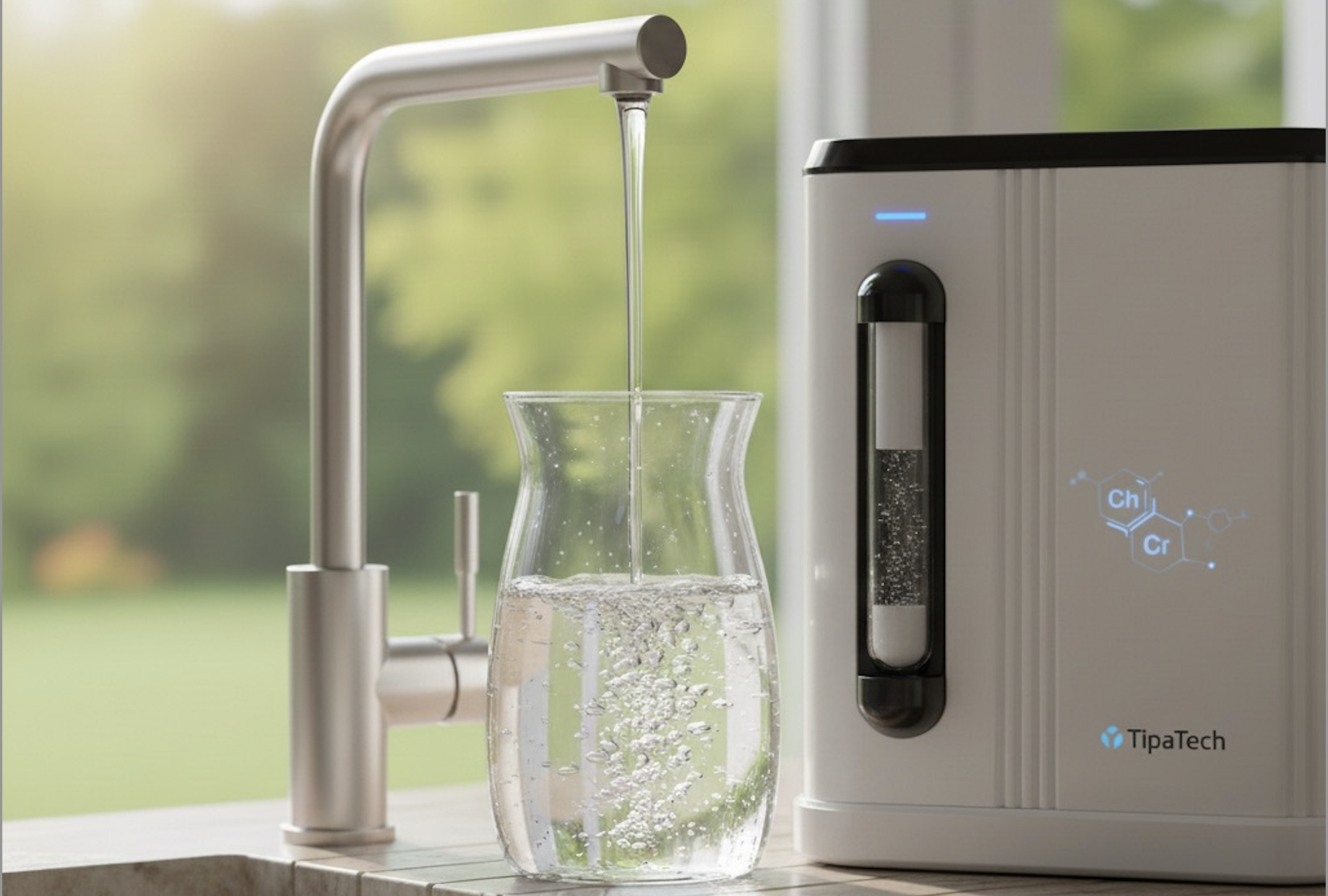
Chlorine and chloramine are both used to control microorganisms in public drinking water, but they are not interchangeable. Their chemistry, persistence, and treatment requirements differ, which is why a filter that performs well for free chlorine may provide limited chloramine reduction.
The first step is to identify which disinfectant your utility uses. Check the annual water-quality report or ask the supplier directly. Taste and odor can provide clues, but they are not a dependable test.
Chlorine and Chloramine: The Core Difference
Free chlorine is reactive and effective for primary disinfection. It tends to dissipate more readily as water moves through the distribution system. Chloramine is most commonly formed when ammonia is added to chlorine. The U.S. EPA explains that chloramines provide longer-lasting secondary disinfection as water travels through pipes.
That stability is useful to utilities, but it also makes chloramine more challenging for household treatment. The CDC overview of chlorine and chloramine emphasizes their public-health role. Household treatment decisions should preserve that context rather than describe regulated disinfection as inherently unsafe.
Why Standard Carbon May Reduce Chlorine More Easily
Activated carbon can reduce free chlorine through reactions at the carbon surface. Performance depends on carbon type, media quantity, flow, temperature, pH, competing compounds, and cartridge age. Chloramine generally reacts more slowly, so the same small cartridge and flow rate may not provide the same result.
For chloramine, effective designs often use catalytic carbon or another media specifically documented for chloramine, together with sufficient bed depth and contact time. A label that says “improves taste” or “reduces chlorine” is not evidence of chloramine reduction.
What a Chloramine Claim Should Include
- The exact product and model tested.
- Influent and effluent chloramine concentrations.
- Flow rate and total capacity.
- Water chemistry and temperature.
- The test standard or laboratory method.
- Replacement and maintenance conditions.
Without those details, it is difficult to translate a laboratory or marketing statement into expected performance in a specific home.
Whole-House Treatment Requires More Than a Cartridge
A point-of-entry system must handle the property’s peak flow while maintaining enough contact time. Undersizing can reduce performance and create pressure loss. Oversizing without a maintenance plan can also create problems. Plumbing material, stagnation, hot-water storage, and microbial control all need to be considered.
Before removing disinfectant throughout a building, discuss the design with a qualified water-treatment professional. Once residual disinfectant is reduced, maintenance, flushing, and avoidance of stagnant conditions become especially important.
Special Uses Need Special Precautions
Chloramine is particularly important for aquariums and dialysis. Fish can be harmed by chloramine, and dialysis water requires specialized treatment and monitoring. A normal drinking-water filter should never be assumed suitable for these uses.
What About Showers and Hot Water?
People often connect disinfectants with shower odor or irritation. Skin and respiratory symptoms can have many causes, and a filter should not be promoted as a medical treatment. For a cautious review, see chlorine in shower water.
Hot water can change disinfectant behavior, but household claims about “gaseous toxins” or inhalation risk require specific evidence. A system’s air-release or gas-management feature should not be presented as chloramine removal unless product-specific testing demonstrates that outcome. Related system concepts are discussed in gases in the water supply.
Choosing Carbon for the Application
Carbon media and housings have operating limits, especially around temperature. Read whether activated carbon can be used with hot water before installing a cold-water cartridge on a shower or hot line.
A Practical Decision Process
- Confirm whether the utility uses free chlorine or chloramine.
- Define whether the goal is taste, drinking-water treatment, or whole-house reduction.
- Request product-specific chloramine data, not a general carbon claim.
- Size the system for actual flow and contact time.
- Monitor performance and replace media before breakthrough.
Conclusion
Chloramine lasts longer than free chlorine and is usually harder to reduce. That does not make treatment impossible, but it makes verification and system sizing essential. Match the media and contact time to the disinfectant, and avoid assuming that every carbon filter provides the same protection.
Frequently Asked Questions
What is the difference between chlorine and chloramine?
Both are drinking-water disinfectants. Chloramine is commonly formed by adding ammonia to chlorine and generally remains in distribution systems longer than free chlorine.
Is chloramine harder to remove than chlorine?
Usually, yes. Chloramine is less reactive and often requires catalytic carbon, more media, slower flow, or longer contact time than free-chlorine reduction.
Does a chlorine filter automatically remove chloramine?
No. A product claim for chlorine reduction should not be treated as a chloramine claim unless the exact model has supporting test data for chloramine under stated conditions.
How can I tell whether my utility uses chloramine?
Check the utility water-quality report or contact the supplier. Taste and odor are not reliable ways to identify which disinfectant is being used.
Should all disinfectant be removed from the whole house?
Not automatically. Removing residual disinfectant can change conditions inside plumbing, so whole-house treatment should be designed, maintained, and monitored for the specific property.