Rust in Household Water
Table of Contents

Scale deposits, also called limescale, are the hard or chalky mineral buildup that appears on faucets, showerheads, kettles, heating elements, and the inside of pipes. They form mainly when hard water contains dissolved calcium and magnesium and conditions cause those minerals to precipitate.

Limescale is usually an operational and maintenance problem rather than proof that water is contaminated. Understanding that distinction helps homeowners choose the right solution instead of treating every white mark as a health emergency.

What Is the Difference Between Hard Water and Limescale?

Hard water contains elevated levels of dissolved minerals, primarily calcium and magnesium. Limescale is the solid deposit that can form from those minerals, particularly when water is heated, evaporates, or moves through changing pressure and temperature conditions. Many deposits are rich in calcium carbonate, although their composition can also include magnesium compounds, corrosion products, and sediment.

The U.S. Geological Survey water-hardness map shows broad regional patterns across the United States, but a national map cannot determine the hardness at a specific address. A utility report or local water test is more useful for an individual property.

Common Signs of Scale Deposits

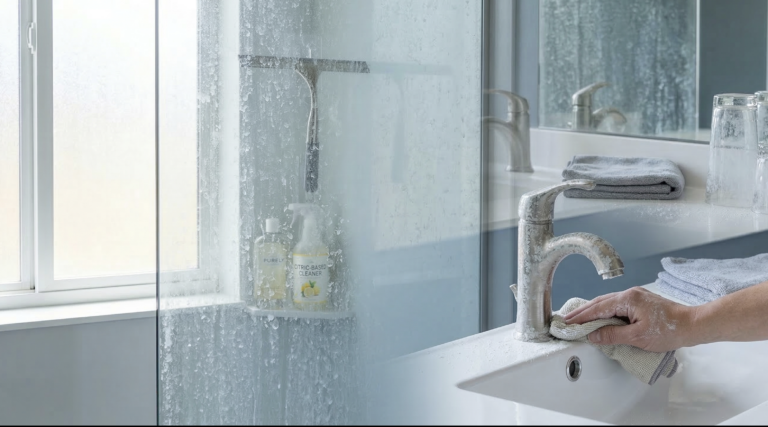
  • White or chalky spots on faucets, glass, sinks, and shower screens
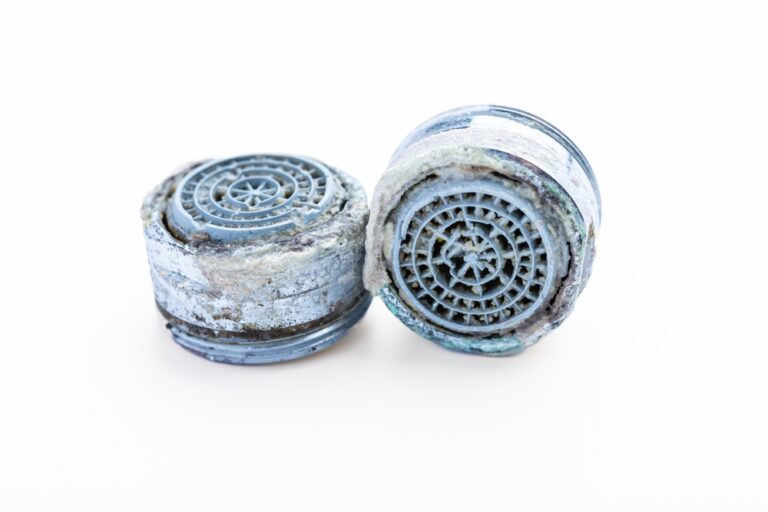
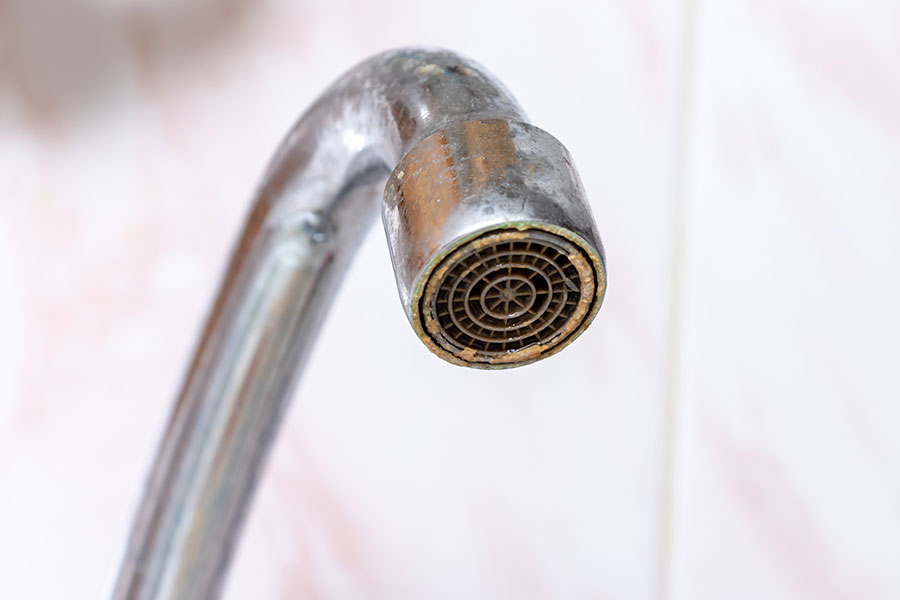
  • Reduced flow through showerheads or faucet aerators
  • Crust inside kettles, coffee makers, and humidifiers
  • Longer heating time or unusual noise from a water heater
  • Frequent need to descale appliances
  • Soap scum or reduced soap lather

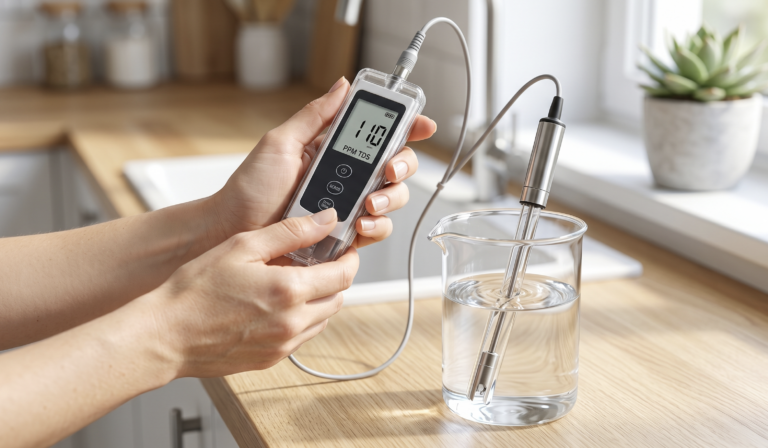
These signs suggest mineral buildup, but they do not reveal the exact hardness level or water chemistry. Testing can distinguish hardness from sediment, corrosion products, and other causes of discoloration or poor flow.

At What Temperature Does Limescale Form?

There is no single temperature at which limescale suddenly begins. Heating can make calcium carbonate more likely to precipitate, so hot-water equipment and heating surfaces are especially vulnerable, but the rate of buildup also depends on hardness, alkalinity, pH, pressure, residence time, and the condition of the surface.

How Scale Affects Fixtures and Appliances

Faucets, Showerheads, and Pipes

Deposits can narrow small openings and gradually restrict flow. Inside pipes, long-term buildup may contribute to lower pressure or uneven distribution, although the severity depends on hardness, temperature, pipe material, and water use.

Water Heaters and Heating Elements

Scale can form on heat-transfer surfaces. This layer may lower heat-transfer efficiency, increase heating time, and contribute to noise or maintenance needs. The effect is not the same in every appliance, and a fixed percentage increase in energy use should not be assumed without measurements.

Dishwashers, Washing Machines, and Coffee Equipment

Mineral deposits can affect spray openings, heating components, and internal surfaces. Hard water can also change how detergents perform, so users may notice spotting, residue, or the need for more frequent cleaning.

Does Limescale Affect Taste, Skin, or Hair?

Hardness minerals can influence taste and mouthfeel, but preference varies. Hard water may also leave mineral residue on skin and hair or interact with soaps and shampoos. These are generally comfort and cleaning issues, not evidence that the minerals are toxic.

People with a specific skin condition should follow medical advice rather than treating water conditioning as a medical treatment.

Is Limescale Dangerous to Drink?

Hardness itself is mainly caused by calcium and magnesium, which are normal dietary minerals. A white deposit does not automatically mean the water is unsafe. However, hardness does not rule out other contaminants either. Review the local water-quality report and test for any issue of concern.

Ways to Manage Scale Deposits

Routine Descaling and Maintenance

Small appliances and removable fixtures can often be cleaned with an appropriate descaling method. Follow the manufacturer’s directions, especially for water heaters, boilers, coffee machines, and appliances with sensitive components.

Ion-Exchange Water Softeners

A conventional softener removes hardness ions and replaces them with other ions, commonly sodium or potassium. This can be effective for hardness reduction, but it requires salt or another regenerant, produces a discharge stream, and changes the mineral composition of the water.

Scale-Conditioning and Anti-Scale Systems

Conditioning systems are designed to reduce the tendency of hardness minerals to form adherent deposits without necessarily removing the calcium and magnesium. They should not be described as softeners unless they actually lower measured hardness.

Sediment and Fine-Particle Filtration

A sediment filter can capture suspended particles, but dissolved hardness passes through many ordinary particle filters. Scale management requires a technology designed for hardness behavior, not merely a finer screen.

For a broader comparison, see Limescale Reduction Methods for Your Home.

How the TipaTech T-18 Approaches Scale

The TipaTech T-18 is designed as a whole-house filtration and water-conditioning system that helps manage scale without salt-based softeners or electrical power. It is intended to reduce scale formation while retaining naturally occurring minerals rather than removing hardness minerals through ion exchange.

Performance depends on source-water hardness, chemistry, temperature, flow, installation, and maintenance. Before selecting a configuration, review the property’s water analysis and the product documentation relevant to the expected conditions.

Installation and Maintenance Matter

Even an appropriate system can underperform if it is incorrectly sized, installed, or maintained. A properly installed and maintained system should account for pipe diameter, peak flow, pressure, source-water quality, drainage or flushing requirements, and cartridge service intervals.

A Practical Decision Process

  1. Confirm the hardness level and identify any other water-quality concerns.
  2. Decide whether the goal is mineral removal, scale management, easier cleaning, or appliance protection.
  3. Compare softening, conditioning, and filtration as different technologies.
  4. Review verified performance data for the actual model and configuration.
  5. Plan for maintenance and monitor results over time.

The Bottom Line

Scale deposits are a visible consequence of hard-water minerals under the right conditions. They can restrict flow, increase cleaning, affect appliances, and reduce heat-transfer efficiency. The best solution depends on whether you want to remove hardness minerals or manage their tendency to form deposits.

Frequently Asked Questions

What causes scale deposits in water systems?

Scale forms mainly when dissolved calcium and magnesium in hard water precipitate onto surfaces. Heating, evaporation, pressure changes, water chemistry, and residence time can all influence buildup.

At what temperature does limescale form?

There is no universal threshold. Heating generally increases the tendency of hardness minerals to precipitate, but buildup also depends on hardness, alkalinity, pH, pressure, residence time, and surface conditions.

Is limescale the same as hard water?

No. Hard water contains dissolved hardness minerals. Limescale is the solid deposit that can form from those minerals on fixtures, heating elements, appliances, and pipes.

Is limescale in drinking water harmful?

Limescale is usually an operational and aesthetic issue rather than evidence that water is unsafe. Hardness minerals are mainly calcium and magnesium, but a water-quality report or test is still needed to assess other contaminants.

How can I reduce limescale without a salt-based softener?

A scale-conditioning or anti-scale system may help reduce adherent deposits without removing the hardness minerals. Performance depends on water chemistry and the specific technology, so review product data and local conditions.

Does a sediment filter remove hard-water minerals?

Usually not. Sediment filters capture suspended particles, while calcium and magnesium hardness are dissolved. A separate softening or scale-management process is generally required.

whole house water filtration systems

Cleaner. Smarter. Healthier

At TipaTech we specialize in advanced whole house water filtration systems designed to protect your health and improve your water at every tap. Our patented technology reduces lead, bacteria, microplastics and harmful chemicals while preserving essential minerals like magnesium. Tested and Certified by IAPMO Compliance to: NSF/ANSI 42/61/372-2022 standards. Our systems deliver safe, eco-friendly, antioxidant-rich water with no electricity, no waste and no compromises.

Make Your Water Smarter

This article is for informational purposes only and is not medical advice. TipaTech products are designed to support water quality, not to diagnose, treat, cure, or prevent any disease. Product performance varies based on source water, usage, and professional installation. TipaTech disclaims any liability arising from reliance on this content.

About the Author

Baruch Ziser

Founder & Senior Scientific Consultant | Inventor of the TipaTech Filtration Systems

Baruch Ziser is a leading expert in water technology with fifty years of experience. As the inventor of TipaTech filters and a senior scientist at the Technion’s INOVATEC program, he has developed advanced water systems that reduce impurities while retaining and adding the necessary minerals for optimal body function. His innovations are recognized globally for improving drinking water quality in homes and agriculture.

The TipaTech Water Filtration Systems have been Tested and Certified by IAPMO

& Compliance to NSF/ANSI/CAN standards

NSF/ANSI/CAN Standards | IAPMO, R&T, UPC and the Standards Council of Canada

More to Know

DID YOU KNOW?  ·  HARD WATER & LIMESCALE

Scale Deposits and Limescale: Causes, Effects, and Prevention

Understand what causes scale deposits and limescale, how hard water affects fixtures and appliances, and how softening and conditioning differ.

By Baruch Ziser Updated July 22, 2026 6 min read
Scale Deposits and Limescale: Causes, Effects, and Prevention
TOPICHard Water & Limescale
READING TIME6 minutes
FIRST PUBLISHEDOctober 14, 2024

Scale deposits, also called limescale, are the hard or chalky mineral buildup that appears on faucets, showerheads, kettles, heating elements, and the inside of pipes. They form mainly when hard water contains dissolved calcium and magnesium and conditions cause those minerals to precipitate.

Limescale is usually an operational and maintenance problem rather than proof that water is contaminated. Understanding that distinction helps homeowners choose the right solution instead of treating every white mark as a health emergency.

What Is the Difference Between Hard Water and Limescale?

Hard water contains elevated levels of dissolved minerals, primarily calcium and magnesium. Limescale is the solid deposit that can form from those minerals, particularly when water is heated, evaporates, or moves through changing pressure and temperature conditions. Many deposits are rich in calcium carbonate, although their composition can also include magnesium compounds, corrosion products, and sediment.

The U.S. Geological Survey water-hardness map shows broad regional patterns across the United States, but a national map cannot determine the hardness at a specific address. A utility report or local water test is more useful for an individual property.

Common Signs of Scale Deposits

  • White or chalky spots on faucets, glass, sinks, and shower screens
  • Reduced flow through showerheads or faucet aerators
  • Crust inside kettles, coffee makers, and humidifiers
  • Longer heating time or unusual noise from a water heater
  • Frequent need to descale appliances
  • Soap scum or reduced soap lather

These signs suggest mineral buildup, but they do not reveal the exact hardness level or water chemistry. Testing can distinguish hardness from sediment, corrosion products, and other causes of discoloration or poor flow.

At What Temperature Does Limescale Form?

There is no single temperature at which limescale suddenly begins. Heating can make calcium carbonate more likely to precipitate, so hot-water equipment and heating surfaces are especially vulnerable, but the rate of buildup also depends on hardness, alkalinity, pH, pressure, residence time, and the condition of the surface.

How Scale Affects Fixtures and Appliances

Faucets, Showerheads, and Pipes

Deposits can narrow small openings and gradually restrict flow. Inside pipes, long-term buildup may contribute to lower pressure or uneven distribution, although the severity depends on hardness, temperature, pipe material, and water use.

Water Heaters and Heating Elements

Scale can form on heat-transfer surfaces. This layer may lower heat-transfer efficiency, increase heating time, and contribute to noise or maintenance needs. The effect is not the same in every appliance, and a fixed percentage increase in energy use should not be assumed without measurements.

Dishwashers, Washing Machines, and Coffee Equipment

Mineral deposits can affect spray openings, heating components, and internal surfaces. Hard water can also change how detergents perform, so users may notice spotting, residue, or the need for more frequent cleaning.

Does Limescale Affect Taste, Skin, or Hair?

Hardness minerals can influence taste and mouthfeel, but preference varies. Hard water may also leave mineral residue on skin and hair or interact with soaps and shampoos. These are generally comfort and cleaning issues, not evidence that the minerals are toxic.

People with a specific skin condition should follow medical advice rather than treating water conditioning as a medical treatment.

Is Limescale Dangerous to Drink?

Hardness itself is mainly caused by calcium and magnesium, which are normal dietary minerals. A white deposit does not automatically mean the water is unsafe. However, hardness does not rule out other contaminants either. Review the local water-quality report and test for any issue of concern.

Ways to Manage Scale Deposits

Routine Descaling and Maintenance

Small appliances and removable fixtures can often be cleaned with an appropriate descaling method. Follow the manufacturer’s directions, especially for water heaters, boilers, coffee machines, and appliances with sensitive components.

Ion-Exchange Water Softeners

A conventional softener removes hardness ions and replaces them with other ions, commonly sodium or potassium. This can be effective for hardness reduction, but it requires salt or another regenerant, produces a discharge stream, and changes the mineral composition of the water.

Scale-Conditioning and Anti-Scale Systems

Conditioning systems are designed to reduce the tendency of hardness minerals to form adherent deposits without necessarily removing the calcium and magnesium. They should not be described as softeners unless they actually lower measured hardness.

Sediment and Fine-Particle Filtration

A sediment filter can capture suspended particles, but dissolved hardness passes through many ordinary particle filters. Scale management requires a technology designed for hardness behavior, not merely a finer screen.

For a broader comparison, see Limescale Reduction Methods for Your Home.

How the TipaTech T-18 Approaches Scale

The TipaTech T-18 is designed as a whole-house filtration and water-conditioning system that helps manage scale without salt-based softeners or electrical power. It is intended to reduce scale formation while retaining naturally occurring minerals rather than removing hardness minerals through ion exchange.

Performance depends on source-water hardness, chemistry, temperature, flow, installation, and maintenance. Before selecting a configuration, review the property’s water analysis and the product documentation relevant to the expected conditions.

Installation and Maintenance Matter

Even an appropriate system can underperform if it is incorrectly sized, installed, or maintained. A properly installed and maintained system should account for pipe diameter, peak flow, pressure, source-water quality, drainage or flushing requirements, and cartridge service intervals.

A Practical Decision Process

  1. Confirm the hardness level and identify any other water-quality concerns.
  2. Decide whether the goal is mineral removal, scale management, easier cleaning, or appliance protection.
  3. Compare softening, conditioning, and filtration as different technologies.
  4. Review verified performance data for the actual model and configuration.
  5. Plan for maintenance and monitor results over time.

The Bottom Line

Scale deposits are a visible consequence of hard-water minerals under the right conditions. They can restrict flow, increase cleaning, affect appliances, and reduce heat-transfer efficiency. The best solution depends on whether you want to remove hardness minerals or manage their tendency to form deposits.

Frequently Asked Questions

What causes scale deposits in water systems?

Scale forms mainly when dissolved calcium and magnesium in hard water precipitate onto surfaces. Heating, evaporation, pressure changes, water chemistry, and residence time can all influence buildup.

At what temperature does limescale form?

There is no universal threshold. Heating generally increases the tendency of hardness minerals to precipitate, but buildup also depends on hardness, alkalinity, pH, pressure, residence time, and surface conditions.

Is limescale the same as hard water?

No. Hard water contains dissolved hardness minerals. Limescale is the solid deposit that can form from those minerals on fixtures, heating elements, appliances, and pipes.

Is limescale in drinking water harmful?

Limescale is usually an operational and aesthetic issue rather than evidence that water is unsafe. Hardness minerals are mainly calcium and magnesium, but a water-quality report or test is still needed to assess other contaminants.

How can I reduce limescale without a salt-based softener?

A scale-conditioning or anti-scale system may help reduce adherent deposits without removing the hardness minerals. Performance depends on water chemistry and the specific technology, so review product data and local conditions.

Does a sediment filter remove hard-water minerals?

Usually not. Sediment filters capture suspended particles, while calcium and magnesium hardness are dissolved. A separate softening or scale-management process is generally required.
FROM INFORMATION TO THE RIGHT NEXT STEP

Not sure what is affecting your water?

Start with the water source, available test results, property conditions and the treatment goal. TipaTech can help review the situation before a system is selected.

Baruch Ziser

ABOUT THE AUTHOR

Baruch Ziser

Founder & Senior Scientific Consultant | Inventor of the TipaTech Filtration Systems

Baruch Ziser is a leading expert in water technology with fifty years of experience. As the inventor of TipaTech filters and a senior scientist at the Technion’s INOVATEC program, he has developed advanced water systems that reduce impurities while retaining and adding the necessary minerals for optimal body function. His innovations are recognized globally for improving drinking water quality in homes and agriculture.

The TipaTech Water Filtration Systems have been Tested and Certified by IAPMO

& Compliance to NSF/ANSI/CAN standards

NSF/ANSI/CAN Standards | IAPMO, R&T, UPC and the Standards Council of Canada

Contact Us