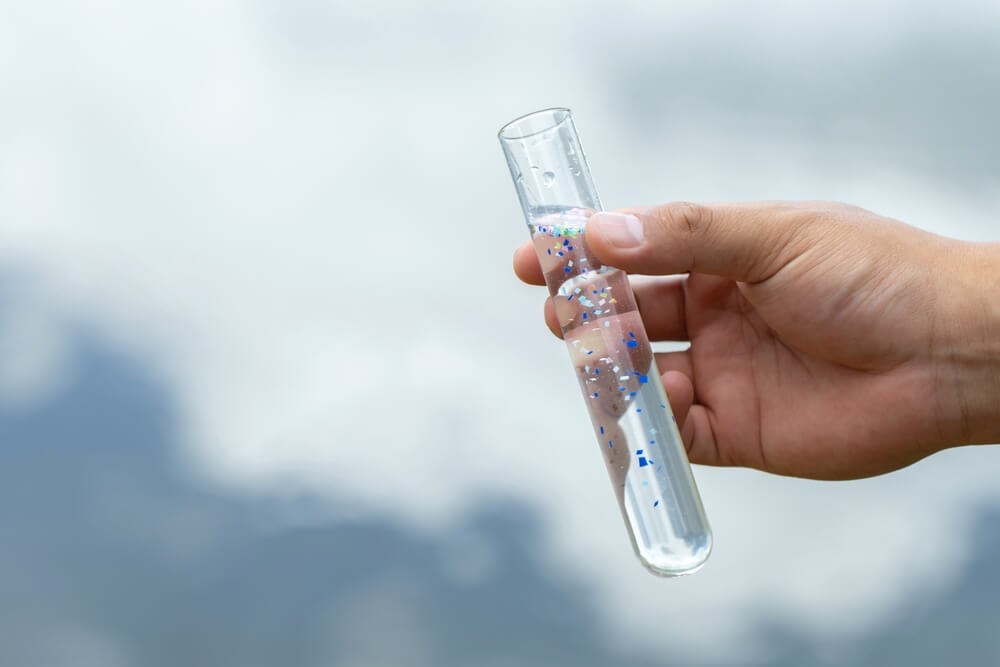
Microplastics in water are a real concern, but the practical response should be evidence-based rather than alarm-based. Plastic particles have been studied in tap water, bottled water, surface water, wastewater, food, air, and human tissues. What is still developing is the science of exposure levels, particle sizes, long-term health effects, and the performance of specific household systems.
The EPA describes microplastics research as an active area focused on measurement, exposure, and potential impacts. That uncertainty matters. It is not responsible to claim that every filter captures every microplastic particle, especially when particles range from visible fragments to nanoplastics far below one micrometer.
What Are Microplastics?
Microplastics are small plastic particles created when larger plastic items break down or when tiny particles are manufactured directly. They can include fibers from textiles, tire-wear particles, fragments from packaging, and particles introduced through industrial or household activity. Nanoplastics are even smaller and require extra caution because they are harder to measure and harder to filter reliably.
How Microplastics Reach Water
Plastic particles can enter source water through stormwater, wastewater, industrial discharge, synthetic fabrics, degraded packaging, tire wear, and breakdown of larger plastic waste. Particles can also be introduced during storage, distribution, sampling, or household use. This is why a headline from one city or one bottled-water study cannot be used to prove the level in a specific home.
What We Know and What We Do Not Know
It is reasonable to say that microplastics are widespread and that researchers are investigating potential health effects. It is not accurate to say that typical household exposure has one proven health outcome, that a person can diagnose exposure from symptoms, or that a home device can eliminate all risk. The more useful question is: which particles can a specific system reduce under defined conditions?
Why Standard Filter Claims Can Be Misleading
A micron rating can help describe particle capture, but it is not a complete performance claim. Reduction depends on whether the rating is nominal or absolute, the particle size and shape, flow rate, cartridge condition, system integrity, water pressure, and how the test was performed. A 1 micron rating may be relevant for some particles, but it does not prove reduction of nanoplastics or dissolved chemicals.
Activated carbon may improve taste and adsorb selected chemicals, but carbon should not be treated as a universal microplastic or microbiological purifier. A sediment filter may capture larger particles, but it does not remove substances dissolved in the water. Membrane systems may provide tighter particle control, but their claims still need model-specific evidence.
Tap Water, Bottled Water, and Plastic Exposure
Switching from tap water to bottled water is not automatically a microplastic solution. Bottled water can contain plastic particles too, and plastic bottles add packaging, storage, and environmental concerns. A better approach is to evaluate the home’s water source and choose a reusable, maintained treatment option when it has a relevant claim.
Where TipaTech Options May Fit
The TipaTech T-18 is a whole-house point-of-entry platform, while Lotus DY is a point-of-use drinking-water option. These roles are different. Whole-house treatment may help with particles and conditions that affect the home broadly, while point-of-use treatment focuses on drinking and cooking water. Any microplastic claim should be tied to the current model documentation and operating conditions.
A Practical Microplastics Action Plan
- Do not rely on TDS meters or taste to detect plastic particles.
- Ask what particle size was tested and under which conditions.
- Check whether the rating is nominal or absolute.
- Maintain cartridges before flow reduction or breakthrough becomes a problem.
- Reduce avoidable plastic contact in storage and daily use.
- Do not confuse particle filtration with removal of dissolved chemicals.
The Bottom Line
Microplastics deserve attention, but broad fear-based claims do not help homeowners choose wisely. Focus on the source, the particle-size range, the exact model claim, and the maintenance plan. A well-matched system may reduce certain particles, but no household filter should be described as eliminating every microplastic, nanoplastic, or environmental exposure.
Frequently Asked Questions
Are microplastics found in drinking water?
Microplastics have been detected in many water environments, including drinking-water studies, but results vary by sampling method, particle size, and location.
Can a home test detect microplastics?
Most consumer home tests cannot reliably measure microplastics. Laboratory analysis requires specialized sampling and identification methods.
Do water filters remove microplastics?
Some fine particle filters and membrane systems may reduce particles within their tested size range. Pore size alone is not enough to prove performance for all microplastics or nanoplastics.
Is bottled water always safer for microplastics?
No. Bottled water and tap water can both contain plastic particles, and study results depend on packaging, storage, sampling, and analytical method.
What is the practical way to reduce exposure?
Use a verified drinking-water system when appropriate, reduce avoidable plastic contact, maintain cartridges on schedule, and avoid claims that promise complete removal of every particle.