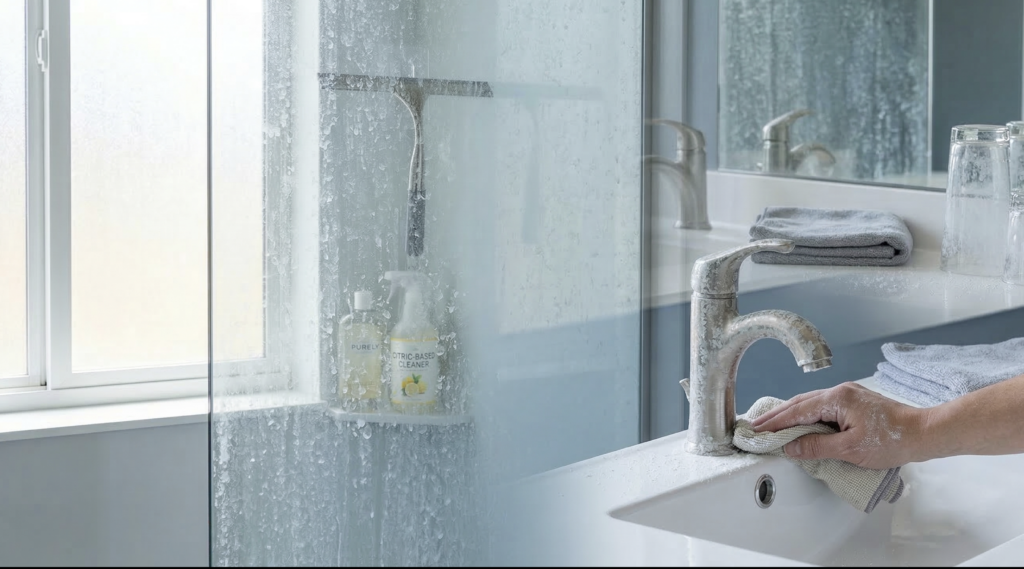
If your shower glass looks clean for about 10 minutes, your faucets have a permanent white “halo,” and your freshly washed glasses come out looking like they’ve been air-dried in a chalk factory: that’s hard water doing what hard water does.
The good news: you can reduce hard water stains without installing a salt-based softener. You just need to understand what causes stains and then apply a few high-impact habits plus (optionally) a salt-free whole-home approach.
Why hard water stains happen (the simple explanation)
Hard water contains dissolved minerals – mainly calcium and magnesium. When water dries, those minerals don’t evaporate with it. They stay behind as scale deposits (white spots, cloudy film, crust on chrome).
And if you use soap in hard water, you often get the “combo platter”: mineral scale + soap scum, which is why bathrooms can look “dirty” right after cleaning.
The no-salt playbook (what actually works in real homes)
1) Stop stains before they “set” (the 30-second habit)
Scale forms when droplets dry. So the fastest win is to reduce how often water gets the chance to dry on surfaces:
- Keep a squeegee in the shower and do a quick swipe after showering.
- Wipe faucets and sinks with a microfiber cloth after use.
- If you have glass shower doors, treat them like a windshield – quick pass, done.
It’s boring. It works.
2) Use cleaners that dissolve minerals (most people use the wrong stuff)
Scale is mineral buildup. General bathroom spray often doesn’t dissolve it well.
Mild acids are commonly used for scale because they help break down alkaline mineral deposits. Household examples include vinegar or lemon juice (and citric-acid based products).
Practical safety notes:
- Don’t use acidic cleaners on natural stone (marble, travertine).
- Spot-test first, especially on coated fixtures.
3) Reduce the “soap scum multiplier”
Hard water + soap can leave that sticky film that makes you feel like you’re always cleaning the same wall.
Simple adjustments that often help:
- Use liquid body wash instead of bar soap.
- Use less product (most people use too much).
- Rinse surfaces well so residue doesn’t dry in place.
This won’t change hardness – but it can decrease the gunk that makes everything harder.
4) Dishes and glassware: stop the spots without buying a new dishwasher
If your glasses always look spotted:
- Use a rinse aid (helps water sheet off instead of drying in droplets)
- Choose detergent formulated for hard water
- Clean the dishwasher filter regularly
This is one of those “small change, big sanity improvement” steps.
The long-term, no-salt solution: reduce scale formation at the source
If you want fewer stains without constantly wiping and descaling, you typically need to address scale before water reaches every fixture.
Salt-free scale control (what it is – and what it isn’t)
Salt-free approaches don’t work like traditional ion-exchange softeners. They generally aim to reduce scale buildup behavior rather than “remove all minerals” or create the slippery feel of softened water.
Realistic expectations:
- You may still see spotting, but it can be less stubborn and easier to clean
- The main goal is usually less buildup and less maintenance, not “perfect glass forever”
- Results vary based on water chemistry and usage
Where TipaTech fits (relatable, low-risk wording)
If your main frustration is “I’m tired of cleaning the same white crust every week,” a whole-home, salt-free approach is often the practical direction.
TipaTech’s T-18 is positioned as a whole-home system designed to help reduce scale impacts across showers, fixtures, plumbing, and appliances – without relying on salt discharge. Like any water treatment approach, outcomes depend on local water conditions, installation, and maintenance, and no system can honestly guarantee “zero stains.”
A lot of households like a simple two-step strategy:
- Whole-home system (like T-18): helps reduce scale pain everywhere
- Under-sink system (like LotusDY): focuses on drinking/cooking water at the kitchen tap
Bonus: don’t forget your water heater
If you’re in hard water territory, sediment and scale can build up in a water heater over time. EPA’s WaterSense home maintenance guidance notes that flushing a water heater can help reduce sediment buildup that can decrease efficiency.
Bottom line
Hard water stains aren’t you “doing something wrong.” They’re minerals doing mineral things. The no-salt path is very doable if you combine:
- quick habits that prevent droplets from drying
- cleaners that actually dissolve mineral deposits
- and (if you want long-term relief) a whole-home approach that helps reduce scale formation