How water quality can affect your hair – and what you can do about it
Most people assume hair loss is only a matter of genetics, nutrition, or hormonal balance. But if you’ve noticed thinning, brittleness, or extra shedding in the shower, your water quality might be playing a role – especially if you live in an area with hard water or heavily chlorinated water coming from the tap.
Here’s what the science says, what’s still debated, and how treating your shower water can help protect your hair and scalp.
What Is Hard Water – and Why It Matters for Hair
Hard water is water with high mineral content, primarily calcium and magnesium ions that it picks up from soil and rock as it moves underground. In everyday use, hard water shows up as:
- Soap that doesn’t lather easily
- Mineral deposits on faucets and shower glass
- A “chalky” feel on skin and hair
These minerals don’t immediately dissolve in the hair shaft, and when they accumulate on the scalp and strands, they can interfere with normal hair care and scalp health. Wikipedia
Does Hard Water Directly Cause Hair Loss?
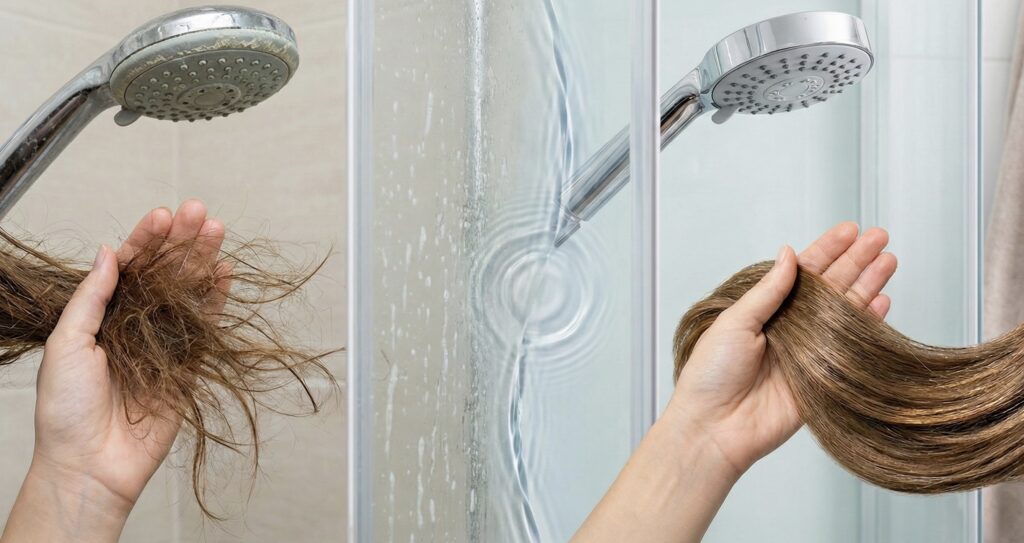
The short answer is not usually in the medical sense – hard water doesn’t make hair follicles fall out at the root. However, scientific evidence and expert commentary suggest that hard water can contribute to conditions that indirectly promote shedding and breakage:
Mineral Buildup and Weakening of Hair
Research shows that hair exposed repeatedly to hard water can become:
- Dry
- Brittle
- More prone to breakage
In one study, hair treated with hard water showed decreased tensile strength compared to hair washed in very pure water, indicating that minerals may weaken hair when exposure is ongoing. PMC
Another review of hair damage and water quality found that mineral film on hair shafts makes it harder for moisture and conditioners to penetrate, leaving hair dry and difficult to manage – which can exacerbate breakage and the appearance of thinning. Healthline
Scalp Irritation and Follicle Stress
Mineral buildup can also collect on the scalp, disrupting its natural oil balance and leading to dryness, irritation, and even inflammation. Over time, irritated scalp skin may weaken follicle function and lead to enhanced hair shedding – again, indirectly contributing to hair loss symptoms. Quinn Water Systems
Important nuance: Some studies find no significant difference in hair tensile strength from hard water alone, and hair loss due to hard water is not firmly established as a direct cause in medical literature. Many researchers emphasize that stress, genetics, diet, hormones, and underlying skin conditions are still the primary drivers of true hair loss. PMC
Chlorine and Water Quality: A Double Whammy
In many municipal systems, chlorine or chloramine are added to disinfect water. While these chemicals keep water safe from pathogens, they can strip the hair and scalp of natural oils, leading to dryness, increased brittleness, and irritation. Over time this dryness can make hair more prone to breakage and shedding – especially for people with sensitive scalps or textured hair. Health
So while chlorine itself doesn’t directly cause follicles to die, its drying effect does contribute to the cascade of conditions that can look like hair loss when hair breaks off more easily.
Water Quality + Hair Care: The Real Connection
Instead of framing hard water as a single cause of baldness, the science points toward a compound effect:
- Mineral buildup on hair and scalp
- Reduced effectiveness of shampoos and conditioners
- Dryness and brittleness
- Scalp irritation and inflammation
- Increased mechanical breakage
All these factors can make it seem like hair is falling out – when in reality it may be breaking off further down the strand.
How Treating Your Shower Water Helps
One of the most effective ways to reduce the adverse effects of hard water and chlorinated tap water is to improve the water quality before it ever touches your hair.
TipaTech’s T-18 Whole-House Filtration System
A whole-home solution like the TipaTech T-18 treats incoming water to make it less harsh and more nourishing for your hair and skin. Here’s how:
- Reduces chlorine and chloramine levels: This decreases the stripping of natural oils from hair and scalp that contributes to dryness and breakage.
- Conditions minerals rather than stripping them out: Unlike basic softeners or overly aggressive filtrations, the T-18 alters how calcium and magnesium behave in water so that they are less likely to cling to hair shafts and scalp skin – helping hair feel softer and less tangled.
- Improves overall water balance: Treating water before it reaches bathroom fixtures means every shower, bath, and rinse benefits – reducing cumulative mineral buildup.
By addressing the water quality at the source, systems like the T-18 can help mitigate the environmental factors that make hair more prone to damage over time.
Practical Hair Health vs. Permanent Hair Loss
To be clear:
- Hard water and chlorine do not usually trigger genetic or hormonal hair loss.
- They can create conditions that make hair brittle, dry, and more prone to breakage, which can be mistaken for shedding or thinning.
- Improving water quality can support hair appearance and strength, especially when paired with good hair care practices and scalp health maintenance.
Bottom Line
Water quality is an often-overlooked piece of the hair health puzzle. While hard water doesn’t directly cause permanent hair loss, its high mineral content and associated chemicals can stress hair and scalp, leading to brittleness, breakage, and scalp irritation that look like shedding. Reducing chlorine exposure and conditioning mineral behavior – for example with a whole-home system like TipaTech’s T-18 – can make your water gentler on hair and skin, supporting healthier strands over the long run.
Sources
- A controlled study found that hair exposed to hard water had decreased tensile strength compared with hair treated with deionized water, suggesting increased vulnerability to breakage. PMC
- Hairstylist and dermatologist guidance indicates that hard water and chlorine can contribute to dryness, brittleness, and hair damage that can resemble hair loss. Health
- General evidence notes hair breakage and dryness associated with hard water mineral buildup, even if direct follicle loss is not firmly linked. Healt hline