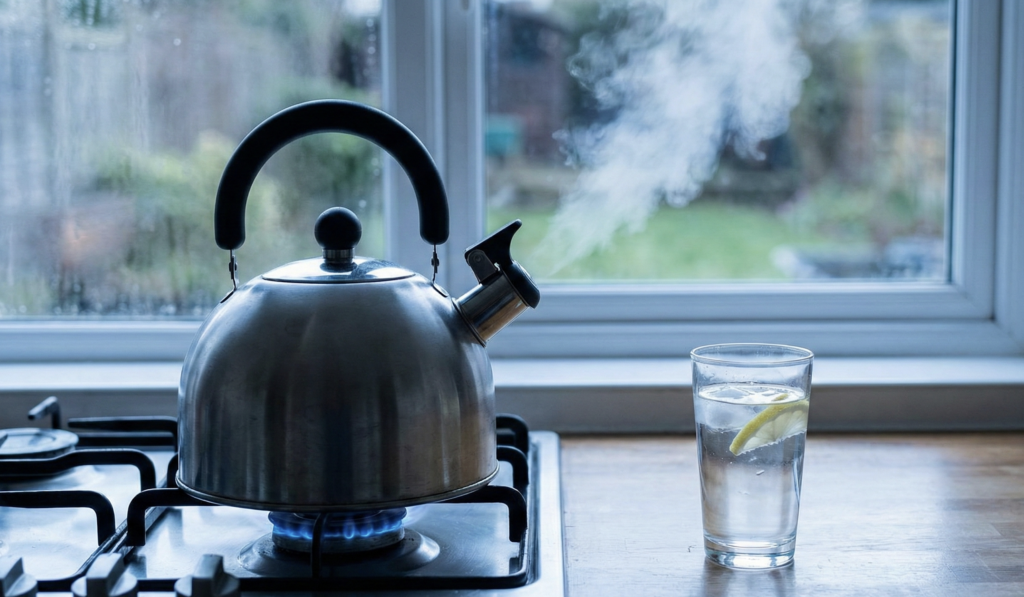
Boiling water is often hailed as the ultimate safety net. Whether you’re on a camping trip or facing a municipal “boil water” advisory, the advice is drilled into us from a young age: “Just boil it, and it’s safe.”
But here is the uncomfortable truth: Boiling was a great solution for the problems of the 1800s, not the 2020s.
In modern water systems, the threats have evolved. We aren’t just dealing with bacteria anymore; we are dealing with complex chemical cocktails. So, let’s bust this myth once and for all: What does boiling actually fix, and more importantly, what dangerous elements does it leave behind?
The Good News: What Boiling Water Actually Does
Let’s give credit where it’s due. Boiling water is a fantastic method for disinfection. It is not, however, a method for purification or filtration. There is a big difference.
When you bring water to a rolling boil for at least one minute (as recommended by the CDC), you are using heat to:
- Destroy bacteria (like E. coli or Salmonella)
- Inactivate viruses (like Hepatitis A)
- Neutralize parasites (like Giardia)
The Verdict: If your main worry is biological like during a flood, a pipe burst, or travel to a region with poor sanitation boiling is a lifesaver. It kills living things in the water effectively.
The Bad News: What Boiling Leaves Behind (Or Makes Worse)
This is where the “just boil it” advice falls apart. Boiling affects biology, not chemistry. If your water contains heavy metals or industrial runoff, heat won’t help you. In fact, it might hurt you.
Here is what survives the kettle:
- The Hidden Toxin Trap (Endotoxins)
Even when boiling “works” by killing bacteria, it tells only half the story. Bacteria involve two main toxin types: Exotoxins (produced by living bacteria) and Endotoxins (held inside the bacteria’s body). While heat kills the bacteria, it causes their cells to burst, releasing the Endotoxins into your water. These toxins are often heat-resistant. So, while you may have killed the messenger, the message (the poison) remains. Boiling doesn’t remove these distinct biological particles; only filtration does. - Heavy Metals (The “Concentration Effect”)
Heavy metals do not evaporate with the steam. They stay right where they are.
- Lead from aging pipes
- Arsenic
- Mercury
- Cadmium
Why it’s dangerous: As water boils, some of it turns to steam and leaves the pot. The metals, however, remain. This means the concentration of lead or arsenic in the remaining water can actually increase relative to the volume of water. You could effectively be brewing a stronger dose of contaminants.
2. Modern Chemical Contaminants
Most modern pollutants are heat-stable. Boiling simply does not remove:
- Pesticides and herbicides from agricultural runoff.
- Pharmaceutical residues.
- PFAS (the notorious “forever chemicals”).
- Industrial solvents.
3. Dissolved Minerals & Limescale
Boiling does not “soften” water. The calcium and magnesium (hardness minerals) remain, often precipitating out as that chalky white limescale you see at the bottom of your kettle. While not necessarily toxic, this affects the taste and texture of your water and doesn’t solve the issue of scale buildup in your appliances.
4. Disinfection By-Products
While boiling might drive off some volatile gases like chlorine, it is inconsistent. It often fails to remove disinfection by-products (DBPs) formed when chlorine reacts with organic matter. These compounds remain in the water you drink.
The “Over-Purification” Trap: Why Empty Water Isn’t the Answer
Realizing that boiling doesn’t work, many people swing to the opposite extreme: Reverse Osmosis (RO) or distilled water that strips everything out.
While this removes the bad stuff, it also removes the good stuff—essential minerals like magnesium and calcium. The World Health Organization (WHO) has noted potential health risks associated with the long-term consumption of demineralized water.
The goal shouldn’t be “empty” water; it should be balanced water.
A Modern Approach: How TipaTech Changes the Game
If boiling is for emergencies and “stripping” water is overkill, what is the middle ground?
Modern water treatment isn’t about heating water up; it’s about intelligent filtration and chemical balance. This is the philosophy behind systems like TipaTech.
Instead of waiting for contaminants to reach your glass, TipaTech systems focus on:
- Targeted Reduction: Addressing heavy metals and chemical contaminants that heat cannot touch.
- Chemistry Management: Stabilizing the water to prevent corrosion (which protects your pipes and your health).
- Mineral Preservation: Keeping the healthy minerals (calcium/magnesium) in the water, exactly where they belong.
The TipaTech Difference: Rather than relying on an old survival tactic like boiling, TipaTech works upstream. It treats the water quality before it flows from your tap, ensuring you aren’t drinking concentrated metals or “dead” demineralized water.
Final Verdict: Should You Boil?
Let’s simplify the decision process.
- BOIL WHEN: You are under a government advisory, camping, or suspect raw sewage/biological contamination.
- DO NOT RELY ON BOILING WHEN: You are concerned about lead, old pipes, chemicals, bad taste, or long-term health.
The Bottom Line Boiling is a short-term patch for emergency survival, not a long-term solution for healthy living.
Clean water requires more than just heat. It requires thoughtful filtration that removes the toxins of the modern world while keeping the minerals your body needs.
Sources & Further Reading
- Centers for Disease Control and Prevention (CDC): Boiling Water for Emergency Disinfection https://www.cdc.gov/natural-disasters/psa-toolkit/boil-water-advisory.html
- World Health Organization (WHO): Household Water Treatment and Health https://www.who.int/teams/environment-climate-change-and-health/water-sanitation-and-health/water-safety-and-quality/household-water-treatment-and-safe-storage
- U.S. Environmental Protection Agency (EPA): Drinking Water Contaminants and Health Effects https://www.epa.gov/sdwa/drinking-water-regulations-and-contaminants